
Vigo County Court Records After Arrest
A Vigo County arrest starts with custody. The person is taken to the Vigo County Jail, booked, identified, and assigned a booking record. That jail record can show the arrest date, booked-on date, arresting agency, arresting officer, booking number, holds, and initial cases when the Indiana County Jail Public Portal has a matching entry. The court record begins when the prosecuting attorney files formal charges in a criminal court. From that point, Indiana MyCase and the clerk's court records channel are the main places to follow the cause number, court events, filed counts, bond orders, amendments, and disposition.
The difference matters. A booking entry is a custody record. Court records after a jail arrest are case records. The booking side may help identify the person and the date of arrest, while the court side shows what the prosecutor filed and what the judge ordered. For current custody, use Vigo County jail inmate records. For booking photos, use Vigo County jail mugshots. For filed charges, hearings, dismissed counts, convictions, and expungement context, use the court record channels below.
Find Vigo County Court Records
Indiana MyCase is the public court case search portal for non-confidential Indiana case information. Vigo County criminal cases may appear there after filing. The Indiana Judicial Branch Vigo County page points users to MyCase and notes that attorneys must e-file in Vigo County, while other users are encouraged to do so. If an older case, document, or copy request is not complete online, the Vigo County Court Records office can be reached through the clerk records request channel at (812) 231-4499.
- Get the person's full name, booking date, arrest date, or booking number from the jail roster or Indiana County Jail Public Portal.
- Search MyCase by name and narrow the search to Vigo County when the filter is available.
- Compare the booking date with new criminal cases, especially when a common name returns several results.
- Open the case and review the cause number, court, charge list, event dates, bond orders, hearings, and disposition fields.
- If the court record is not online or a copy is needed, call Vigo County Court Records at (812) 231-4499.
The Vigo Sheriff's Court Information page adds local routing context. Terre Haute City Court handles most traffic infractions and many criminal misdemeanors. Vigo County also has Drug Court, IV-D Court, Veterans Court, and Superior Courts 1 through 6. Court times can change, and the jail states that questions about court matters should go to the inmate's attorney or the right court, not to jail staff.
Vigo County MyCase Search Fields
The research snapshot for MyCase was partly dynamic, but the available official help and portal view still show the main public access pattern. Public users can search non-confidential case information without signing in. An account may show extra authorized features, but it is not the basic route for checking whether charges were filed after a Vigo County jail arrest.
| Field or Control | Type | Required | Use in a Vigo County Arrest Case |
|---|---|---|---|
| Search cases | Dynamic public portal | N/A | Opens Indiana public case search from the Office of Judicial Administration. |
| Sign in | Account link | Optional | Public search can be used without sign-in, while account access may add authorized document options. |
| Case number or party search | Search fields | Varies | Use a cause number when known or search by defendant name after a booking. |
| County filter | Dynamic filter | Optional | Choose Vigo County to reduce unrelated Indiana cases. |
The Indiana Courts MyCase public search interface is the right visual match for court records after a Vigo County arrest because it shows the case-search entry point, not the jail roster.
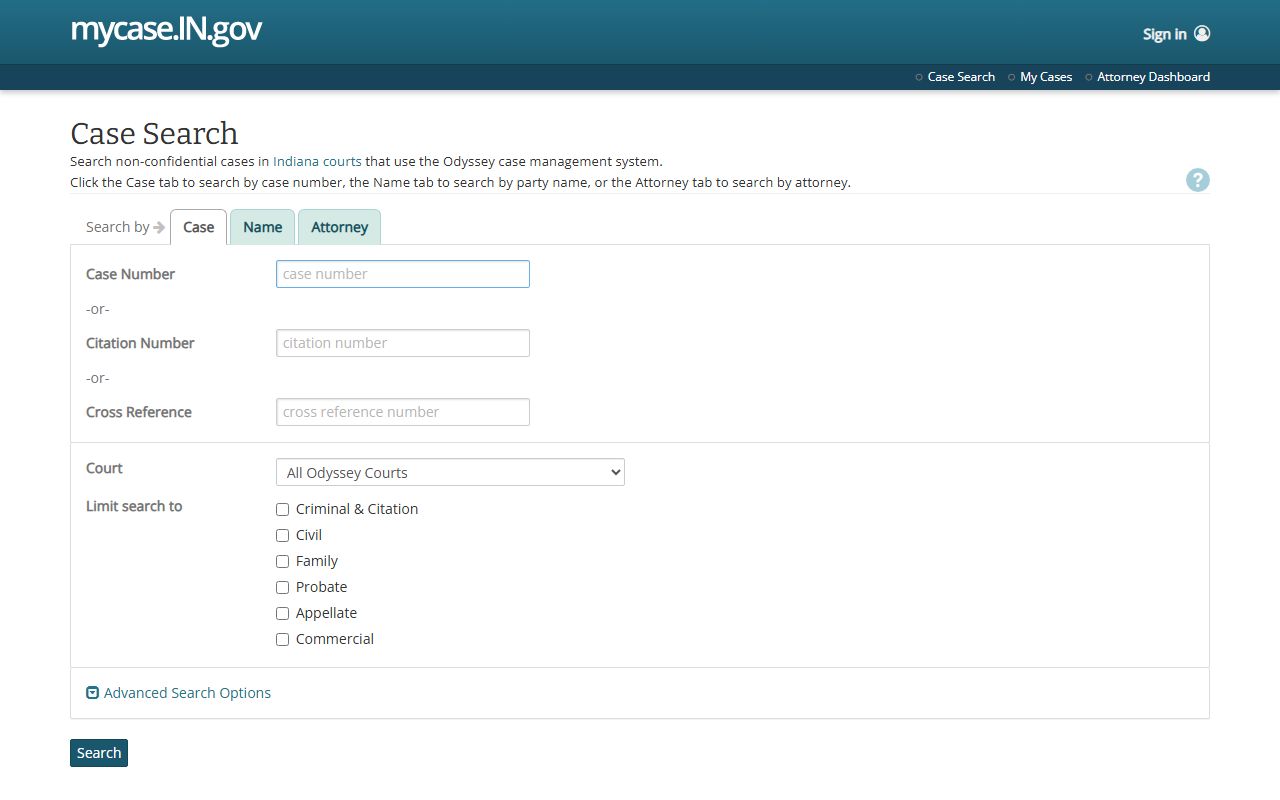
Use the case portal together with the booking date and name from the jail record. That comparison helps separate a newly filed Vigo County criminal case from older cases with the same party name.
Vigo County Charging Documents
After a jail arrest, the Vigo County Prosecuting Attorney reviews police and arrest information and decides whether formal charges should be filed. Indiana uses prosecuting attorneys rather than district attorneys. In Vigo County, the prosecuting attorney is Terry Modesitt, and the Criminal Division is listed at the Vigo County Courthouse. The charging document is the point where the court record becomes more than a booking note. It states the offense the State is pursuing and gives the court a case to track.
| Document | Who Files or Starts It | How It Fits After Arrest |
|---|---|---|
| Complaint | Often based on law-enforcement facts and prosecutor review | May start a criminal case and support probable-cause review after booking. |
| Information | Prosecutor | Common formal charging document for many Indiana criminal cases. |
| Indictment | Grand jury | Used when charges come through a grand-jury process, most often in more serious matters. |
The prosecutor's page lists the Criminal Division at (812) 462-3305 and the courthouse address at 33 S 3rd St, Terre Haute, IN 47807. The office hours in the official contact block are Monday-Friday 8 a.m.-4 p.m., closed noon-1 p.m. Court copies still route through the court records office or MyCase, not through the prosecutor as a general public copy desk.
Vigo County Charge Status
Charges can change after an arrest. A jail record may reflect the arresting agency's first view of the incident, while the court record reflects what the prosecutor filed. The prosecutor may decline a count, file a different count, add a count, reduce a count, or dismiss a count later. That is why a reader should not treat the jail charge and the filed court charge as identical without checking MyCase or court records.
| Status | Plain Meaning | Why It Matters |
|---|---|---|
| Filed | The prosecutor or court has opened a formal charge. | The court record now controls case tracking. |
| Pending | The charge is active and unresolved. | Future hearings, bond orders, and motions may still change the case. |
| Amended | The charge was changed after filing. | The final court charge may differ from the original booking charge. |
| Reduced | The charge was lowered to a different offense or level. | This can affect bond, plea terms, and sentencing exposure. |
| Dismissed | The charge ended without a conviction on that count. | Dismissal does not erase every public record by itself. |
| Convicted | A plea or finding resulted in conviction. | The record moved beyond accusation to a formal outcome. |
| Disposition | The final outcome of a charge or case. | Disposition is the key field for understanding what happened. |
Bond After Vigo County Arrest
Bond is set through the court process, even when the person remains at the Vigo County Jail. The Vigo Sheriff's Inmate Bond Information page gives one important local rule: commercial bonds or bondsmen are not accepted unless approved by the court. That means a person should confirm the court order before assuming a bondsman can post. Bond details may appear in MyCase, but callers should also confirm current custody, case court, payment method, and holds with the jail or the court before making a trip.
| Bond or Hold Type | How It Works in Court Records After Arrest |
|---|---|
| Cash bond | Money is posted directly as the court orders. |
| Court-approved surety | A commercial bond may be used only when the court has approved it. |
| Personal recognizance | Release is based on the person's promise to appear, if the court orders it. |
| No-bond hold | Posting money will not release the person while the hold remains. |
| Detainer or agency hold | Another county, probation, parole, federal, or ICE-related hold may block release. |
To post bond from the available official information, first confirm the custody record, then confirm whether the case is in Vigo County court or Terre Haute City Court. Next, check MyCase or contact the court, because the jail does not control court scheduling. Before going to the jail, call (812) 462-3226 to confirm the amount, the payment method, the court-approved bond status, and whether any other hold blocks release.
Vigo County Arrest Warrants
No official Vigo County active criminal warrant search page was located in the inspected sheriff pages. The sheriff homepage lists Tax Warrants and Civil Process, but those are not the same as a verified public criminal warrant database. For a court warrant after a missed hearing or case event, start with MyCase and look for warrant, failure-to-appear, served, or recalled entries in the event history. For official direction, call the Sheriff's Office at (812) 462-3226 or the court records channel at (812) 231-4499.
- Arrest warrant
- A court order authorizing arrest.
- Bench warrant
- A judge-issued warrant, often tied to failure to appear or a court-order violation.
- Search warrant
- An order to search a place or item, not always an order to arrest a person.
- Fugitive hold
- A custody hold because another jurisdiction seeks the person.
Unofficial warrant databases should not be treated as final. If a person believes a warrant exists, the safer path is to contact counsel or the issuing court before appearing at the jail, because bond and hold status can decide whether release is possible.
Vigo County Charges vs Convictions
An arrest and a charge are not proof of guilt. A charge is an accusation filed or tracked in court. A conviction is a final result after a plea or finding. Vigo County court records after a jail arrest may show both, but the two should not be mixed together when reading a case, assessing a person's status, or describing what happened.
| Point of Comparison | Charge | Conviction |
|---|---|---|
| Stage | Accusation after arrest or filing | Final result after plea or finding |
| Proof level | Based on probable cause and filing decisions | Requires a guilty plea or proof beyond a reasonable doubt |
| Record location | May appear in jail data and MyCase | Appears as the court disposition when public |
| Use caution | Can be amended, reduced, or dismissed | Still may be eligible for later relief under Indiana law in some cases |
Sealed and Expunged Records
Indiana expungement law is separate from the first public view of court records after a jail arrest. Indiana Code 35-38-9 governs expungement, including relief for eligible arrest records when charges do not result in conviction or other statutory criteria are met. A court order is the key document. It should be directed to the records custodians that maintain the case, jail, or agency record.
| Point of Comparison | Sealed | Expunged |
|---|---|---|
| Public visibility | Hidden from ordinary public access when the order applies | Restricted under the expungement order and treated under the statute's rules |
| Source of change | Court order or confidentiality rule | Court order under Indiana expungement law |
| Typical trigger | Confidential case type, protected material, or granted sealing relief | Eligible dismissal, non-conviction arrest, or qualifying disposition |
| Practical step | Check MyCase and contact the clerk for the order's effect | Use the order when asking a record custodian to update an official record |
Important: Vigo County Inmate Population is not a consumer reporting agency, and case or custody data may not be used for FCRA-regulated decisions.
Vigo County Court Access Limits
Indiana's Access to Public Records Act favors access to public agency records, but it does not open every record tied to an arrest. IC 5-14-3-5 is the daily-log statute for basic arrest and jailed-person information. IC 5-14-3-4 lists exemptions for confidential records, many investigatory materials, juvenile records, medical information, and other protected content. MyCase also notes that public users can search non-confidential case information and many documents, but some documents are not online and older cases may be limited.
The clerk's Vigo County Court Records request page is the local backup when online court records after an arrest are incomplete. It gives the court records phone line as (812) 231-4499. Use a focused request with the person's name, cause number if known, date range, and the records being requested. A narrow request is easier to route than a broad demand for every record tied to an arrest.
Note: Court records show filed case activity, while jail records show custody activity; both can be public, but they are maintained by different offices.